Window frame material affects the whole-window U-value (Uw), acoustic performance, lifespan, and maintenance intervals. In Poland, uPVC has dominated the residential market for two decades, but aluminium profiles with thermal breaks are growing in both renovation and new-build commercial projects. Timber retains a presence in the premium residential segment and in historic building contexts where appearance standards apply.
How frame material enters the U-value calculation
The whole-window U-value is calculated according to EN ISO 10077-1 as a weighted average of glass area, frame area, and the linear thermal transmittance of the edge zone (Ψ). A poorly insulating frame can meaningfully raise Uw even when a high-performance glazing unit is used. For a window where the frame represents 20–30% of the total area, frame Uf values between 1.0 and 2.5 W/m²K produce noticeably different outcomes.
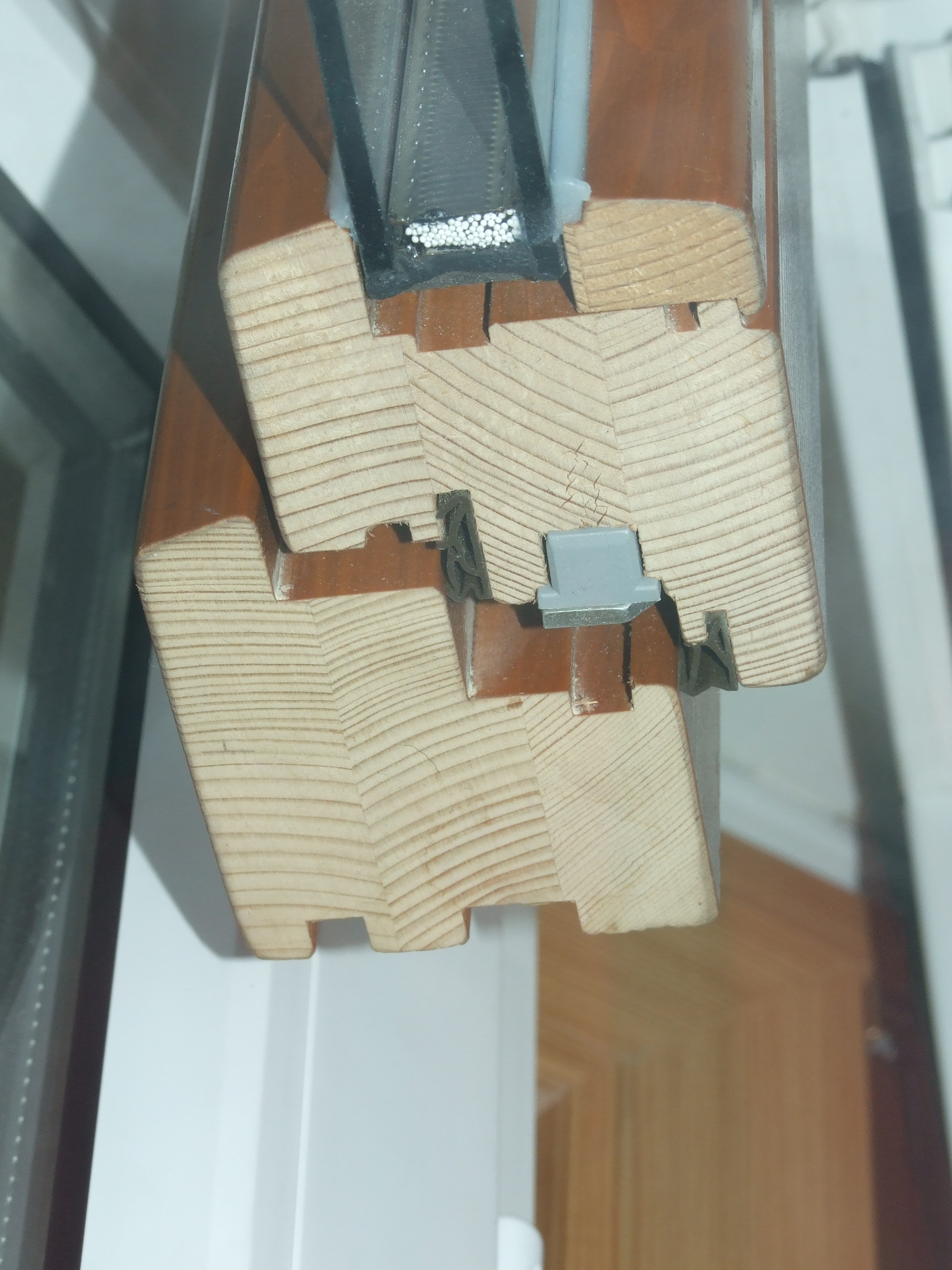
Cross-section of an EURO 68 timber window profile with insulated glazing. Source: Wikimedia Commons, CC BY-SA.
uPVC frames
Unplasticised polyvinyl chloride (uPVC) became the standard residential window material in Poland through the 1990s and 2000s. The material is extruded into multi-chamber profiles; the hollow chambers act as insulating air pockets. The number of chambers and the wall thickness of the profile determine the frame thermal resistance.
Thermal performance
A three-chamber uPVC profile typically achieves Uf values of 1.5–2.0 W/m²K. Five-chamber and six-chamber profiles, which are now standard in new installations, achieve 1.0–1.4 W/m²K. Some manufacturers offer profiles with additional insulation inserts (foam-filled or aerogel-filled chambers) that push Uf below 1.0 W/m²K. Combined with a triple-pane glazing unit, these can produce whole-window Uw values below 0.9 W/m²K.
Durability and maintenance
uPVC profiles are resistant to moisture, do not require painting, and have low maintenance requirements under Polish conditions. UV stabilisers have improved significantly since early 1990s formulations, and correctly specified profiles (meeting EN 12608 classification) are expected to maintain dimensional stability for 30 or more years. Colour choices are limited compared to aluminium; wood-effect foil laminates are widely available but add cost.
Reinforcement
uPVC profiles for larger sashes are reinforced with steel or aluminium inserts to maintain structural rigidity. The insert breaks the thermal continuity of the profile, which is why frame U-value data from manufacturers should be checked for the specific reinforcement configuration used.
Aluminium frames with thermal break
Aluminium extrusions have high structural strength but conduct heat readily (thermal conductivity ~200 W/mK vs ~0.16 W/mK for uPVC). Without intervention, an aluminium frame would produce Uf values in the range of 5–7 W/m²K. All aluminium window profiles for thermal applications in Poland include a polyamide thermal break — a strip of low-conductance polymer that separates the inner and outer aluminium sections.
Thermal break width and performance
Thermal break width is a key variable. A 20 mm polyamide break is common in standard commercial windows. Passive house-grade aluminium systems use breaks of 36 mm or more and add aerogel or foam insulation within the cavity, achieving Uf values down to 0.9–1.2 W/m²K. These are used in high-specification new commercial or residential buildings in Poland where slim sight lines are architecturally required and uPVC profiles are not acceptable.
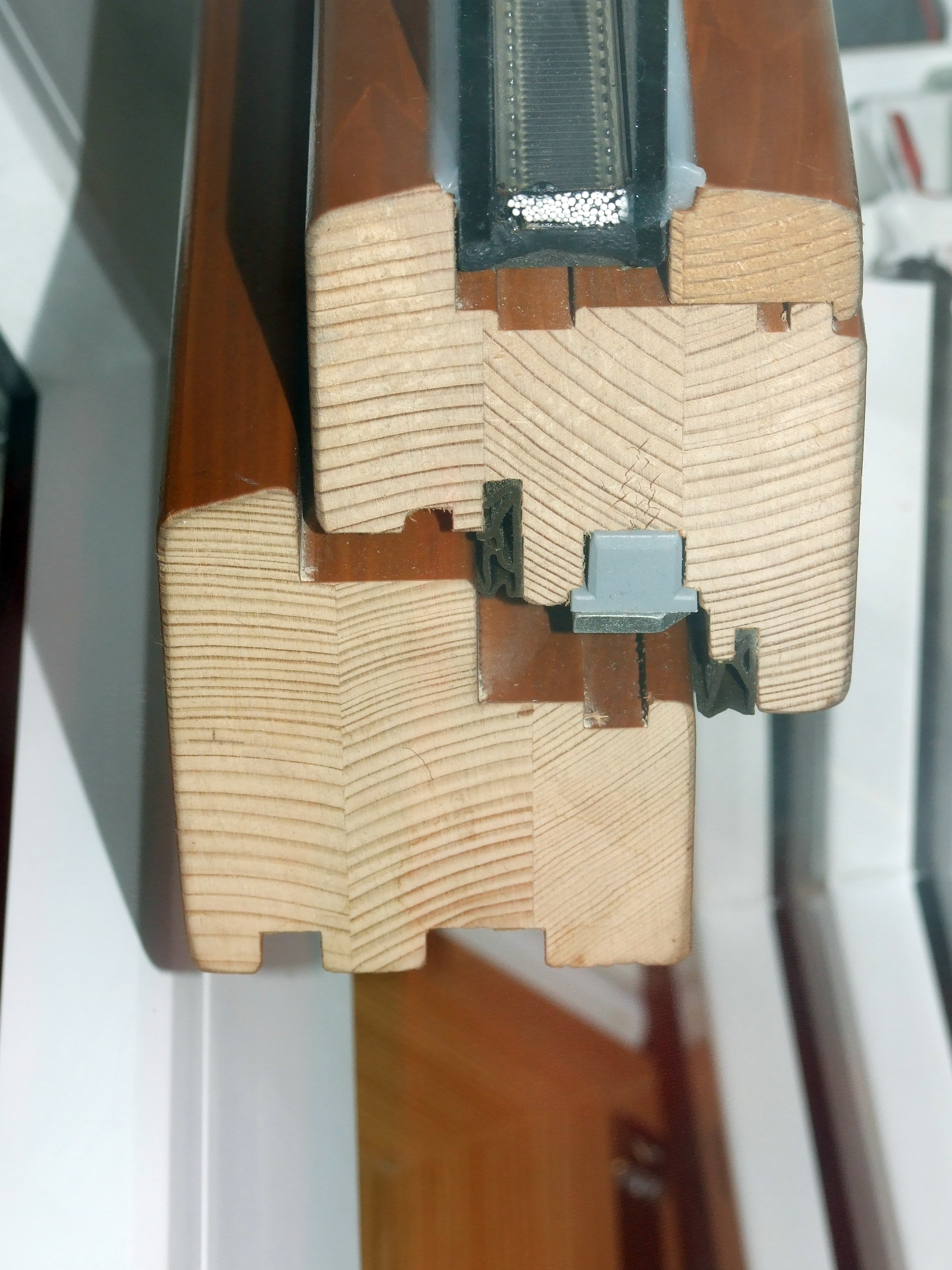
Window profile with glazing bead detail, relevant to installation of large-format glazing units. Source: Wikimedia Commons, CC BY-SA.
Durability and surface options
Aluminium profiles are available powder-coated in any RAL colour, anodised in metallic finishes, or clad with timber on the interior face (aluminium-timber composite). The surface is stable under UV exposure and does not require periodic painting. Aluminium windows are common in Polish commercial construction — offices, retail, facades — and in contemporary residential where large openings or tilt-and-slide systems are specified.
Timber frames
Timber is a good natural insulator (thermal conductivity ~0.13 W/mK for dry softwood), and solid timber profiles achieve Uf values around 1.0–1.4 W/m²K depending on species and profile depth. Engineered (laminated) timber profiles reduce the risk of warping and splitting associated with solid wood in variable climate conditions.
EURO 68 and similar profile systems
The EURO 68 profile system (68 mm depth) is widely used in Polish joinery workshops that produce bespoke timber windows. It is compatible with double or triple insulated glazing units and uses standardised hardware fittings. Deeper profiles (92 mm, 104 mm) are used for passive-standard timber windows, accommodating thicker triple-pane units.
Maintenance requirements
Timber frames require periodic painting or varnishing, typically every 5–10 years depending on exposure. South and west elevations receive more UV and moisture stress. Failure to maintain the surface coating leads to moisture ingress, swelling, and eventual rot. Aluminium-clad timber (exterior aluminium, interior timber) eliminates the need to maintain the exterior surface while retaining the aesthetic of natural wood internally.
Regulatory and heritage context in Poland
In historic districts (obszary ochrony konserwatorskiej) and buildings listed on the heritage register (rejestr zabytków), window replacement may require approval from the voivodeship monument conservation officer (Wojewódzki Konserwator Zabytków). Timber windows are often the only permitted replacement type in these contexts. Some local conservation plans specify profile dimensions, glazing bar patterns, and finish colours.
Composite frames
Aluminium-timber composites use timber on the interior and aluminium on the exterior. The two parts are connected mechanically or with flexible joints that allow independent thermal movement. Uf values are comparable to high-performance timber profiles. These are the most expensive option and appear predominantly in premium residential projects in Poland.
Frame material comparison
| Material | Uf range (W/m²K) | Maintenance | Typical lifespan | Market segment (PL) |
|---|---|---|---|---|
| uPVC (5–6 chamber) | 1.0 – 1.4 | Low | 30+ years | Mass residential |
| uPVC with insulation insert | 0.8 – 1.0 | Low | 30+ years | Passive / NZEB residential |
| Aluminium + thermal break (20 mm) | 1.4 – 2.0 | Very low | 40+ years | Commercial, modern residential |
| Aluminium + wide thermal break (36 mm+) | 0.9 – 1.2 | Very low | 40+ years | High-spec commercial |
| Timber (EURO 68) | 1.0 – 1.4 | Medium (5–10 yr cycle) | 50+ years (maintained) | Premium residential, heritage |
| Aluminium-timber composite | 0.9 – 1.2 | Low (exterior) | 40+ years | Premium residential |
Polish procurement context
Window manufacturers operating in Poland must demonstrate CE marking under EN 14351-1 (windows and external doors — performance characteristics). The declaration of performance (DoP) for each product includes Uw, air permeability class, water tightness class, and wind resistance class. When replacing windows in multi-unit residential buildings or commercial projects, specifiers typically request EN 14351 DoPs alongside EN ISO 10077-calculated Uw certificates.
The Polish classification system under WT 2021 does not distinguish between frame materials; it only sets the maximum Uw. Choice of material is therefore a technical and commercial decision rather than a regulatory one, except in heritage contexts.
References
- EN ISO 10077-1:2017 — Thermal performance of windows, doors and shutters
- EN ISO 10077-2 — Numerical method for frames
- EN 12608 — Profiles of unplasticized polyvinyl chloride (PVC-U)
- EN 14351-1 — Windows and external pedestrian doorsets
- Rozporządzenie Ministra Infrastruktury z dnia 12 kwietnia 2002 (WT, as amended 2021)