The number of glass panes in a window unit determines the available space for insulating gas and low-emissivity coatings, which together drive thermal performance. In Poland, where heating seasons regularly last five to six months, the difference between double and triple glazing translates directly into annual heat loss figures at the building envelope level.
How glazing units are measured
Thermal transmittance for glass is expressed as the centre-of-glass U-value (Ug), calculated according to EN 673. The whole-window U-value (Uw) accounts for the frame and edge effects and is derived using EN ISO 10077-1. Polish building regulations reference Uw, not Ug, which means frame selection affects compliance even when the glazing unit itself performs well.

Cross-section diagram of a double-glazed window unit. Source: Wikimedia Commons, public domain.
Single pane
Single-pane windows consist of one sheet of glass with no cavity. Ug values for uncoated 4 mm float glass fall around 5.7–5.8 W/m²K. These windows are no longer installed in new Polish residential construction and have not met minimum standards for decades. They remain visible in older pre-war townhouses and unrenovated 1970s panel blocks, where replacement is often constrained by budget or heritage protections.
Secondary glazing — a separate inner pane added inside an existing single-pane frame — can reduce heat loss substantially without full replacement, though the result still falls short of WT 2021 requirements for new construction.
Double pane (IGU)
An insulated glazing unit (IGU) consists of two glass panes separated by a spacer bar and sealed to retain the cavity gas. The spacer sits around the perimeter of the unit; the material used for the spacer significantly affects edge heat loss and condensation risk.
Air-filled double glazing
Early double-pane units from the 1990s and early 2000s were typically filled with dry air. Ug values for a 4/16/4 configuration (4 mm glass, 16 mm air cavity, 4 mm glass) run around 2.7–2.9 W/m²K. No low-e coating. These units are still common in the 2000s-era Polish housing stock and represent the baseline for much of the current renovation market.
Argon-filled with low-e coating
Replacing air with argon (thermal conductivity ~0.016 W/mK vs ~0.025 W/mK for air) and adding a single low-emissivity coating on pane surface 2 or 3 reduces Ug to approximately 1.0–1.2 W/m²K for a 4/16/4 configuration. This is the current standard for new double-pane units sold in Poland and, depending on the frame, can approach WT 2021 limits.
Low-e coatings are thin metallic oxide layers applied to the glass surface. They reflect long-wave infrared radiation back into the room while remaining largely transparent to visible light. Solar-control variants (used in south-facing or heavily glazed facades) also reduce solar heat gain in summer.
Warm-edge spacers
Traditional aluminium spacers conduct heat well and create a thermal bridge at the glass edge. Warm-edge spacers made from stainless steel, foam, or plastic composites reduce this edge conductance and lower the psi (Ψ) value used in EN ISO 10077-2 calculations. In a well-specified double-pane unit, switching from aluminium to a warm-edge spacer can reduce the whole-window Uw by 0.1–0.2 W/m²K.
Triple pane
Triple-pane units add a third pane and a second sealed cavity. The additional mass increases weight, which affects frame sizing and hardware. A typical triple-pane unit for the Polish market runs around 32–44 kg/m², compared to 18–24 kg/m² for double pane. This has practical consequences for sash sizing, hinge specification, and lintel load.
Argon-filled triple glazing
A 4/14/4/14/4 triple-pane unit (14 mm argon cavities) with two low-e coatings achieves Ug values around 0.5–0.7 W/m²K. At the whole-window level with a good uPVC or timber frame, Uw figures of 0.7–0.9 W/m²K are achievable. This meets WT 2021 requirements and satisfies the thresholds for the Polish “Czyste Powietrze” subsidy programme, which sets Uw ≤ 0.9 W/m²K as a condition for grant eligibility on window replacement.
Krypton-filled triple glazing
Krypton (thermal conductivity ~0.009 W/mK) provides better insulation than argon in thinner cavities. This allows a thinner overall unit depth, which can matter for retrofitting into existing window rebates. Ug values around 0.5 W/m²K are achievable. Krypton is more expensive and less commonly specified in standard residential projects in Poland; it appears more frequently in nearly-zero energy building (NZEB) specifications and certified passive house projects.
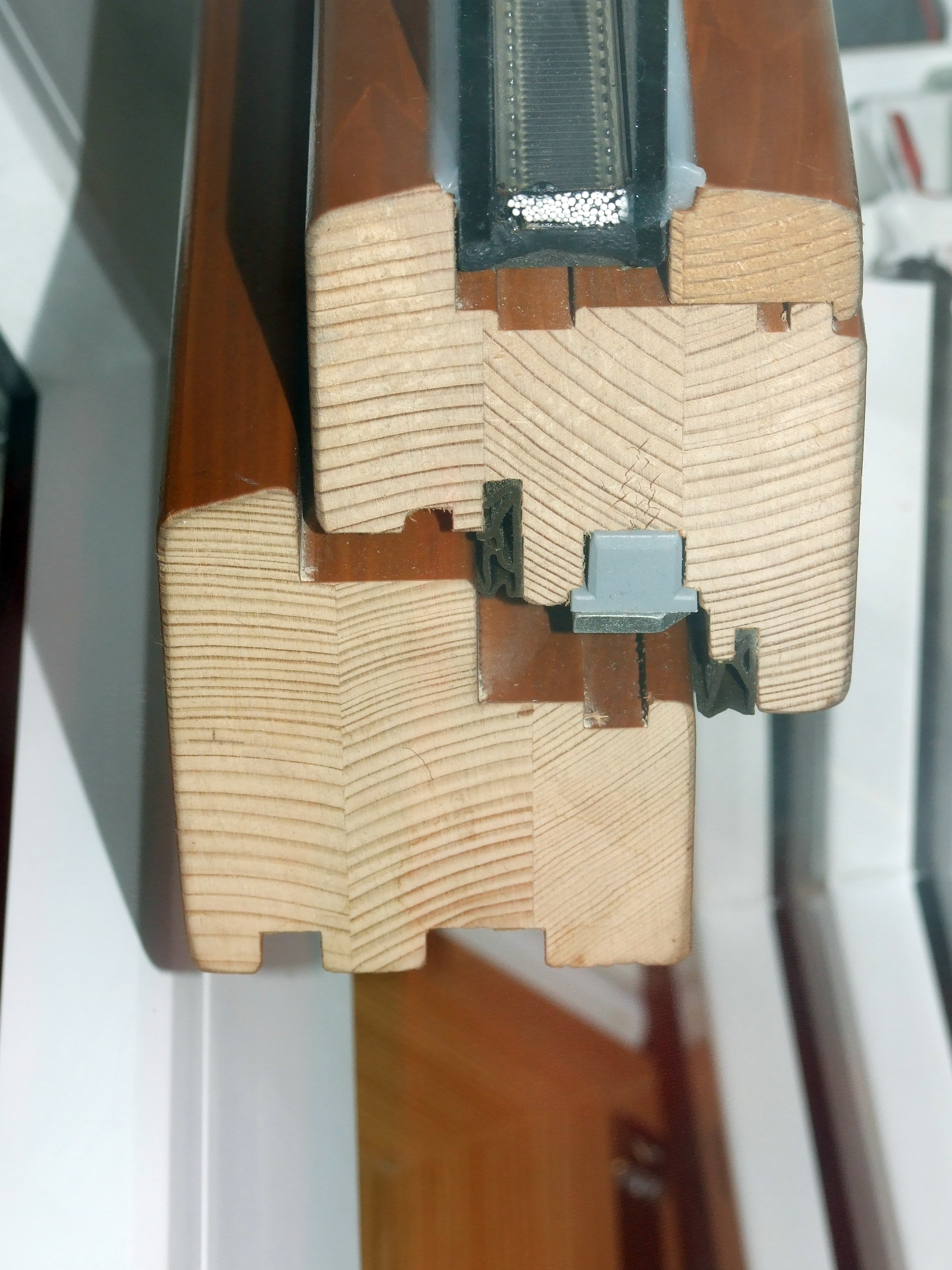
Timber window frame profile with insulated glazing unit installed. Source: Wikimedia Commons, CC BY-SA.
Glazing comparison table
| Configuration | Ug (W/m²K) | Gas fill | Low-e coatings |
|---|---|---|---|
| Single pane (4 mm float) | ~5.8 | — | None |
| Double pane, air (4/16/4) | 2.7 – 2.9 | Air | None |
| Double pane, argon + low-e (4/16/4) | 1.0 – 1.2 | Argon | 1 |
| Triple pane, argon + 2× low-e (4/14/4/14/4) | 0.5 – 0.7 | Argon | 2 |
| Triple pane, krypton + 2× low-e | 0.4 – 0.5 | Krypton | 2 |
Climate context: why triple pane matters in Poland
Poland spans climate zones corresponding to heating degree day (HDD) values ranging from roughly 2,700 in Wrocław to over 3,500 in Suwałki. The colder northeastern regions make a stronger case for triple glazing than the warmer southwest. EN ISO 13790 and the PHPP passive house calculation tool both allow building-level energy modelling that accounts for window U-values, solar heat gain coefficients (SHGC/g-value), and orientation.
South-facing windows with a higher g-value contribute passive solar gain in winter; this needs to be balanced against summer overheating risk. Some Polish passive house designers specify different glazing configurations for south versus north elevations to optimise this balance.
Relevant standards and references
- EN 673:2011 — Determination of thermal transmittance (U-value) of glazing
- EN ISO 10077-1 — Thermal performance of windows, doors and shutters
- EN ISO 10077-2 — Numerical method for frames
- Rozporządzenie Ministra Infrastruktury w sprawie warunków technicznych (WT 2021) — Poland's technical building conditions
- NFOŚiGW — Czyste Powietrze programme